 |
 |
| Great BLUE MARBLE - Our Solar System & Space Exploration |
 |
The
First Animal In
Space The first animal in space was a female dog named "Laika", which means barker in Russian. Laika went into space in Sputnik II on November 3, 1957. Korabl or Sputnik 5, was launched On August 19, 1960, and on board were the dogs "Belka" (squirrel) and "Strelka" (little arrow). Also on board were 40 mice, 2 rats, and a variety of plants. The USA sent a 44 month old chimpanzee named "Ham" on board Mercury Capsule No. 5 on January 31, 1961 from Cape Canaveral for a sub-orbital flight. On October 18, 1963 "Felix", a black and white tomcat reported as being from the streets of Paris, became the first cat in space when he was launched on board an AGI Rocket by France. |
| Laika prior to her space flight. |
Our Solar System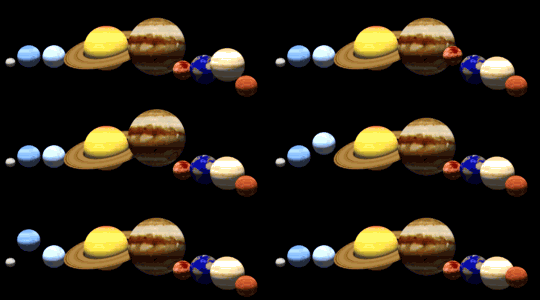 |
|
Our Sun is a star located at the center of our Solar System. Our Solar System is located on the outside edge of our Galaxy. Our Galaxy is called the Milky Way. There are billions of other stars in our Galaxy, and there are billions of galaxies in the Universe. Most of the stars and galaxies we see at night are so far away that it takes hundreds, even thousands, of years for their light to reach Earth. |
Our
Sun & Closest Star |
Distances in the Universe are measured by Light Years. The Sun is 93,000,000 miles away from our Earth, and it takes more than eight minutes for the Sun's light to reach Earth. The next nearest star, Proxima Centauri, is about 270,000 times farther away, and it takes more than four years for this star's light to reach Earth. Sunspots have a pattern of energy release, that follow an 11 year cycle. |
|

|
|||
 |
 |
||
| Click
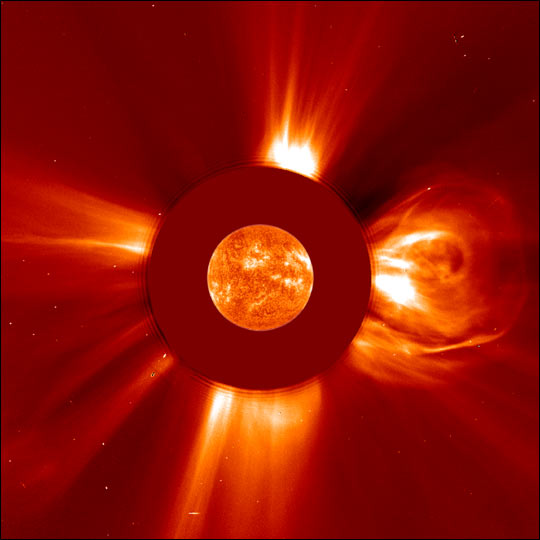
on the NASA image above for a larger image. |
This is
a NASA image of the largest ever recorded solar flare on April 21, 2001.© NASA |
||
|
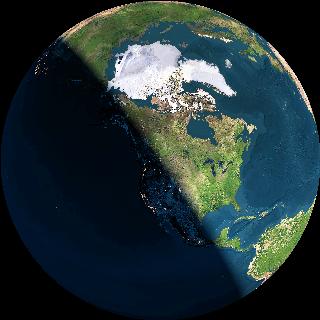
The Earth is roughly 4 times larger than our Moon. The Earth and the Moon are exerting gravitational pulls on each other. The image below shows how we see the moon's phases from earth. 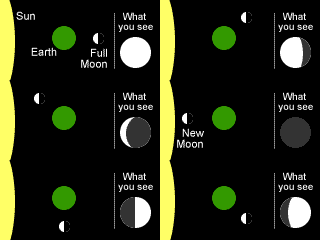 |
Earth & Moon |
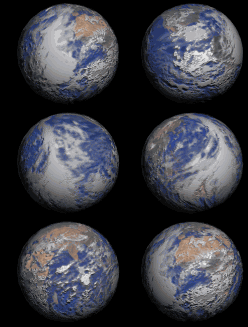
The side of Earth that is nearer the Moon has a stronger pull from the Moon than Earth's far side. This unequal force stretches earth in the Moon's direction. Our solid Earth does not stretch much, less than a foot, however the oceans are lifted up towards the moon by about two feet. The rotating Earth brings the resulting bulge past any given coastline twice a day, thus causing the world's tides. |
 |
||
 |
 |
 |
 |
 |
| Mercury | Venus | Earth | Mars |
| There are nine planets
revolving around our Sun. The four planets closest to the Sun are referred to as the terrestrial (Earth-like) planets. In order of proximity to the Sun, they are Mercury, Venus, Earth, and Mars. Mercury is the smallest inner planet, about 1/3 the size of Earth's diameter. The surface of Mercury that faces the Sun reaches over 700ºF or about 400ºC, and the side away from the Sun drops to -274ºF or -170ºC. Venus is about the same size as Earth, and Mars is about 1/2 Earth's diameter. |
|||
 |
 |
 |
| Jupiter | Earth | Saturn |
| Jupiter and Saturn are Jovian or giant gas planets. Jupiter is 11.2 times larger than Earth, and has a mass 318 times that of Earth. Jupiter is more massive than all the other planets combined. Saturn is 9.5 times larger than Earth. Saturn has a large moon called Titan. For comparison, see how tiny the Earth
is when put between the two giants.Jupiter has at least 16 satellites ( moons ), and four of them are larger than Pluto. |
||
 |
 |
 |
| Uranus | Neptune | Pluto |
|
The most distant planets are Uranus, Neptune, and Pluto. Uranus and Neptune are both about four times larger than Earth's diameter. Like Jupiter and Saturn, Uranus and Neptune are Jovian or gas giants. Pluto, discovered in 1930, is the smallest and most distant planet. Many astronomers consider Pluto to be a comet and not a planet. Pluto is actually closer to Earth than Neptune for 20 years of its 248-year orbit around the Sun. |
||
|
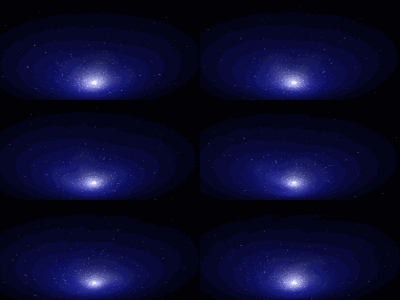
A Black Hole
is a region in the universe which has enormous density. So enormous that nothing can escape its intense gravitational pull. Not even light can escape the immense gravity of a Black Hole. |
Black Holes |
 |
| Comets, Meteors, and Shooting Stars | ||
 |
 |

|
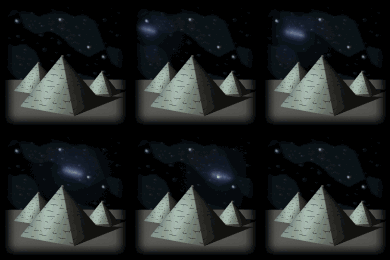
A Comet is a large chunk of ice and rock that can leave a tail of dust debris over 50 million miles long. From ancient times to the present day many comets, such as Haley's Comet, have returned to appear in our night sky. Meteors are more common than comets. Meteors are often referred to as falling stars, and appear as a flash of light as they enter Earth's atmosphere. Meteors are particles as small as dust, generally coming from comet debris, and are called meteorites when they strike Earth. In July, 1994, 22 fragments of Comet Shoemaker-Levy 9 impacted Jupiter over a six day period. This was the first time we have witnessed a collision in our Solar System. |
||

|
Man on the Moon | |
 |
 |
 |
|
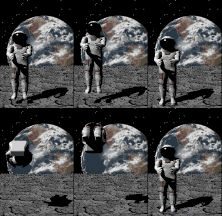
Apollo 11 landed on the moon on July 20, 1969, and
Neil Armstrong became the first human to walk on a solid surface beyond earth. This was perhaps the greatest scientific achievement in the history of mankind. |
||
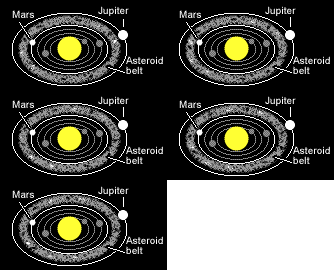 Location of Asteroid Belt within Our Solar System |
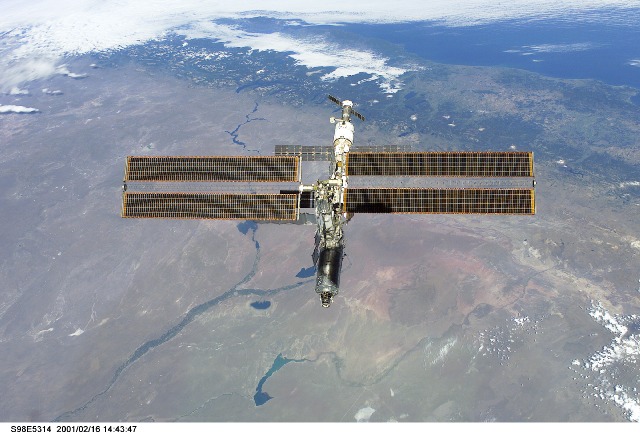 Photo of International Space Station taken by Atlantis crew Feb 2001. Click on the image for a larger view. |

 |

|

|
| Proverbs to Live By The sky is the daily bread of the eyes. Emerson |
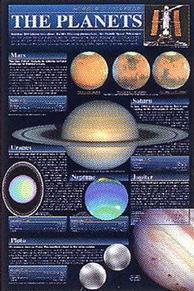
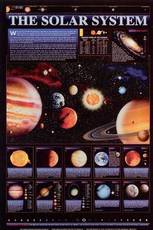 Space Charts The Solar System Poster The Planets Poster |
|
Proverbs to Live By One can see the heavens through a needle's eye. Japanese Proverb |
 |
Zambia .zm |
Great
Blue Marble thanks the
people of the world who have visited us. |
Kazakhstan .kz |
 |
|
|
|

|
| Please click on the Alien Animation to go to Amazing Space Images & Space Facts. | ||
| Getting Around Site |
Alphabet & Baby Names |
Amazing Pics & Facts |
Animal Info & Facts |
Sea
& Sky Animals |
Cartoon World |
Cartoon Animals |
Sounds
& Fun / Games |
| Home | Alphabet | Wildcats/Sea | Dinosaur Den | Sea Animals | People Toons | Animal Toons | Sounds/Songs |
| Enter Site | A-G Animals | Africa/Forest | World Zoos | Dolphins | Love Toons | Zoo Toons | Animal Find |
| Index Page | H-N Animals | Pets/Farm | On the Farm | Sky Birds | Creatures | Farm Toons | Animal Quiz |
| About Us | O-Z Animals | Space/Earth | Insect Garden | Penguins | Planets/Space | Pet Toons | Fun Sayings |
| Contact Us | Baby Animals | Nature/Earth | Coming Soon | Moonlight | Continents | Sea Toons | Farm Quiz |
| Animation © Animation Factory | © GreatBlueMarble.com 2000-2009 All Rights Reserved | Poster Art © Art.com |